
In today’s competitive manufacturing landscape, uptime is everything. When machines stop, production halts, deadlines slip, and costs spiral. Traditional reactive maintenance—fixing equipment only after it fails—no longer cuts it in an industry where even a few hours of downtime can result in massive financial losses.
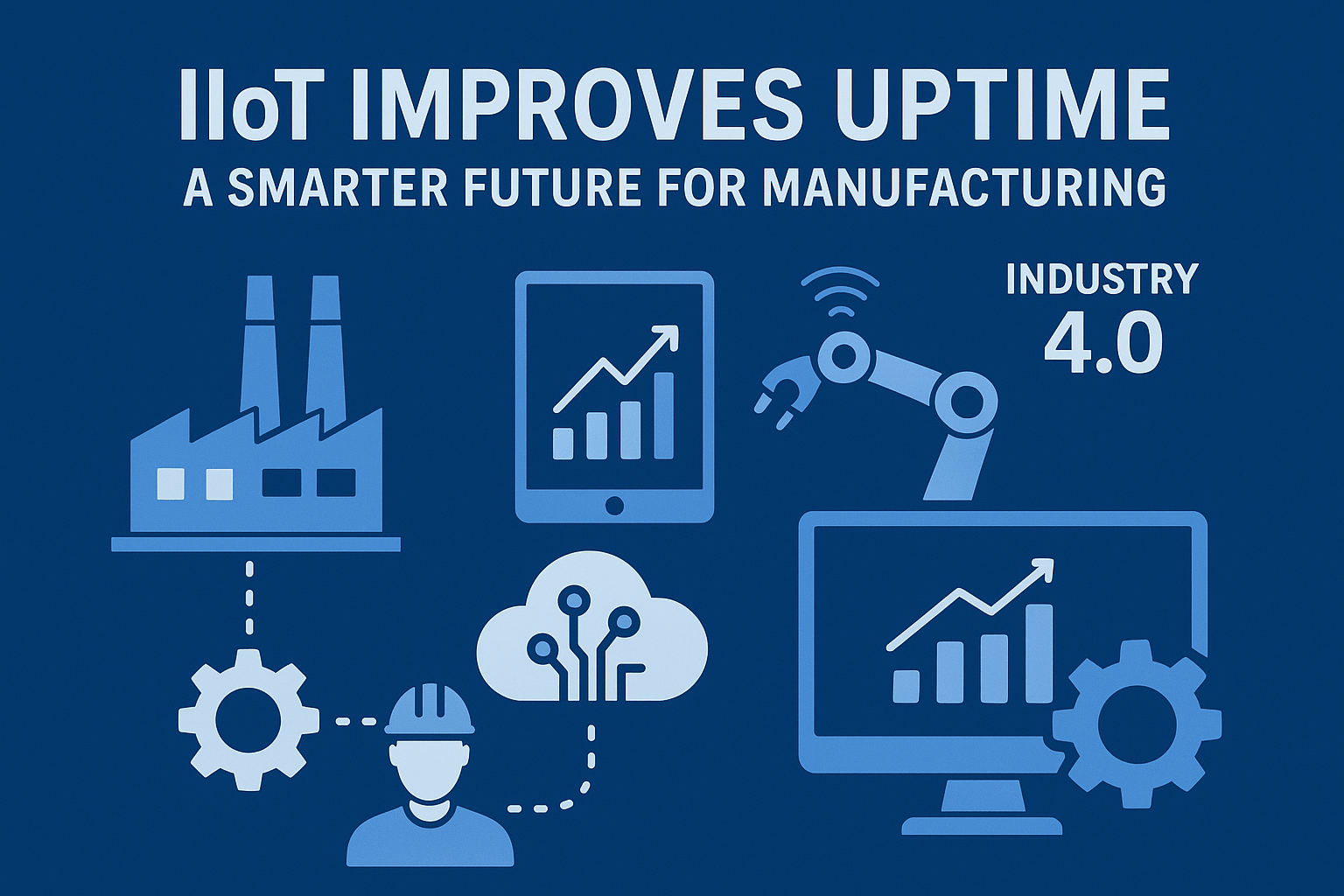
Enter the Industrial Internet of Things (IIoT), a game-changing technology that connects machines, sensors, and systems to the cloud, delivering real-time visibility, alerts, and data-driven insights. By empowering manufacturers to predict issues before they occur, IIoT not only maximizes uptime but also transforms how plants operate.
This blog explores what IIoT is, how it improves uptime, the real-world benefits it offers, and how companies like ICS make it possible without overhauling entire systems.
What Is IIoT?
The Industrial Internet of Things (IIoT) refers to the integration of connected devices, intelligent sensors, and software platforms in industrial environments. Unlike consumer IoT (think smart homes or wearables), IIoT is designed specifically for industries like manufacturing, energy, oil & gas, and pharmaceuticals, where reliability, precision, and uptime are critical.
Here’s how it works:
- Machines and equipment are equipped with sensors that collect data such as vibration, temperature, energy consumption, and output levels.
- This data is transmitted in real time to a cloud platform or local server, where it is analyzed by AI-driven algorithms.
- Operators, engineers, and managers receive alerts, dashboards, and reports, enabling them to make faster, smarter decisions.
The result is a data-driven factory where issues are predicted, inefficiencies are identified, and continuous improvements are made possible.
How IIoT Improves Uptime
The ultimate goal of IIoT is to maximize equipment uptime, and it does so through several powerful applications.
1. Predictive Maintenance
Unplanned downtime is often the single largest source of lost productivity. Traditionally, manufacturers relied on preventive maintenance—scheduled servicing at fixed intervals. While better than waiting for a breakdown, preventive maintenance can be inefficient: equipment might be serviced too early (wasting resources) or too late (leading to failure).
With IIoT, predictive maintenance becomes possible. Sensors continuously monitor parameters such as:
- Vibration anomalies that indicate bearing wear
- Temperature spikes suggesting motor overload
- Pressure changes pointing to leaks or blockages
AI models analyze this data to predict failures before they occur. Maintenance teams can act at the right time—not too early, not too late—preventing costly downtime and extending equipment life.
Example: A food processing company installed IIoT-enabled vibration sensors on its mixers. Early fault detection allowed them to replace failing parts during scheduled downtime, preventing unexpected stoppages and saving thousands of dollars per incident.
2. Energy Monitoring for Efficiency and Reliability
Energy inefficiencies are often invisible until bills skyrocket. But energy consumption can also be an indicator of machine health.
IIoT-powered energy monitoring identifies:
- Machines consuming excess power due to mechanical wear
- Equipment idling unnecessarily, adding hidden costs
- Opportunities to optimize energy-intensive processes
By cutting waste, companies not only save on energy bills but also reduce the risk of overheating or system overload that can cause downtime.
Example: A pharmaceutical plant used IIoT to track energy usage across production lines. The system revealed a compressor running continuously even when demand was low. By fixing this inefficiency, they cut energy costs and reduced stress on the equipment, improving uptime.
3. OEE Dashboards for Continuous Improvement
Overall Equipment Effectiveness (OEE) is the gold standard metric for measuring manufacturing performance, combining availability, performance, and quality.
IIoT-enabled OEE dashboards provide real-time insights into:
- Which machines are underperforming
- Where bottlenecks are occurring
- How downtime, changeovers, or quality issues impact output
Instead of relying on delayed, manual reports, plant managers can see live data and take immediate corrective action. This not only improves uptime but also boosts productivity across the board.
4. Remote Monitoring and Support
Modern manufacturing rarely happens at a single site. Global operations and multi-location plants demand centralized oversight.
With IIoT, equipment and processes can be monitored remotely, in real time. Engineers receive alerts on their mobile devices, and support teams can troubleshoot without needing to be physically present.
Benefits include:
- Faster fault resolution through remote diagnostics
- Reduced Mean Time to Repair (MTTR) by identifying problems before technicians arrive
- Optimized workforce allocation, as fewer on-site interventions are needed
Example: An automotive supplier implemented IIoT across three plants. When a critical fault occurred at one location, remote experts analyzed the issue via live data and guided on-site staff to resolve it within hours—avoiding days of downtime.
The Real-World Impact of IIoT on Uptime
The measurable impact of IIoT adoption is significant:
- 30–40% improvement in uptime thanks to predictive and condition-based maintenance
- Faster fault resolution, enabled by real-time data and remote support
- Reduced MTTR (Mean Time to Repair) by ensuring maintenance teams arrive prepared with the right tools and parts
- Improved planning for spare parts, manpower, and production schedules
These results translate directly into higher productivity, lower operating costs, and greater customer satisfaction.
ICS: Enabling IIoT Without Full System Replacement
One of the biggest misconceptions about IIoT is that companies must completely replace their existing infrastructure. In reality, many manufacturers already have PLC and SCADA systems in place—what they need is intelligent integration.
This is where ICS adds value. By integrating IIoT capabilities with existing PLC/SCADA systems, ICS delivers:
- Intelligent visibility into machine and process data
- Scalable solutions that grow with business needs
- Minimal disruption, avoiding costly rip-and-replace projects
Whether starting small with a single line or scaling IIoT across multiple plants, ICS ensures manufacturers gain real-time visibility, smarter insights, and higher uptime—without reinventing the wheel.
Conclusion: Building Resilient, Uptime-Driven Operations
In an industry where every minute of downtime matters, IIoT is a powerful enabler of uptime, efficiency, and resilience. By connecting machines, sensors, and systems to the cloud, manufacturers can prevent failures, optimize energy use, monitor OEE in real time, and even manage operations remotely.
The results are clear: higher uptime, reduced costs, and smarter decision-making. More importantly, IIoT sets the foundation for future-ready, digital manufacturing ecosystems.
With the right partner, such as ICS, companies can integrate IIoT seamlessly into their existing systems—turning data into action, action into uptime, and uptime into profitability.